There is an undeniable, timeless appeal to a natural wood fence Santa Monica. The rich color of redwood, the rustic charm of cedar—these materials provide a warmth and natural beauty that synthetic products strive to imitate. At GAGA US Construction, we appreciate this classic aesthetic, but we also believe in full transparency with our clients: a wood fence in Santa Monica is a significant investment that faces unique environmental challenges.
The very same coastal air that makes this city a beautiful place to live—a persistent mix of salt air, fog, and humidity—is a constant threat to lumber. This environment can accelerate rot, cause warping, and invite pests.
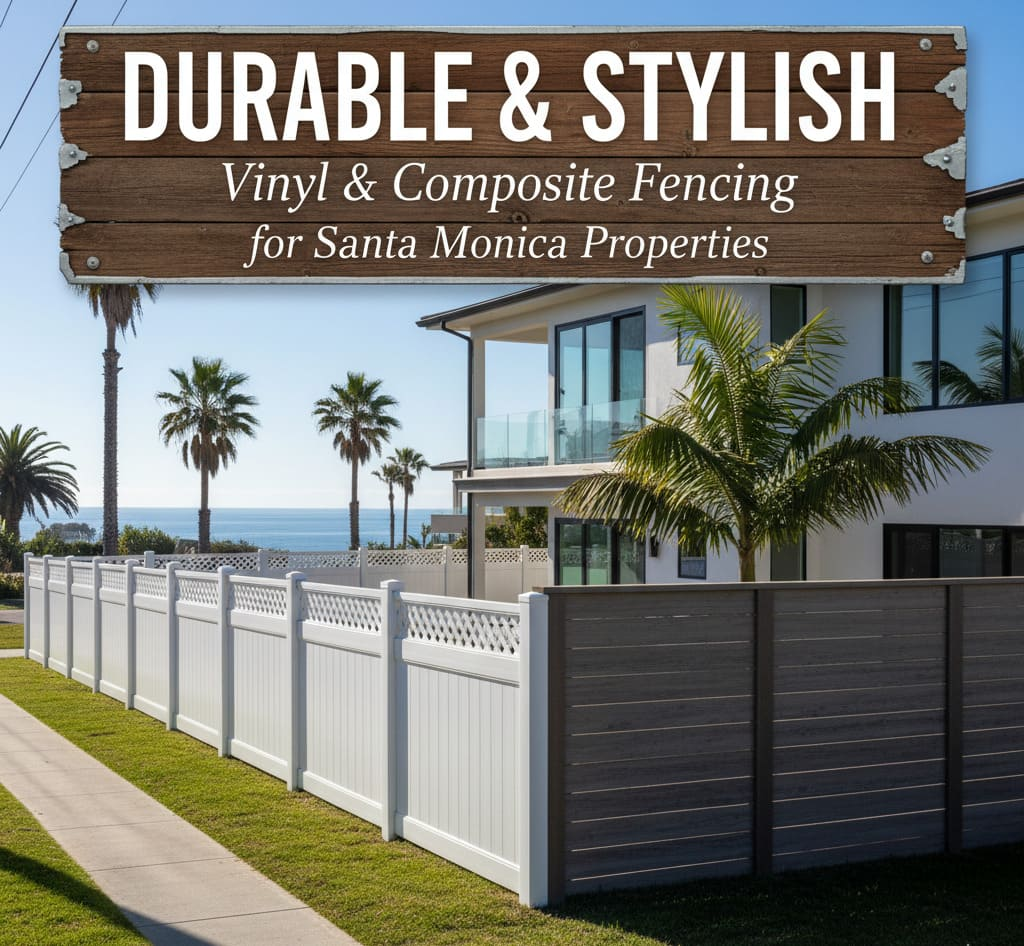
For property owners seeking a “set it and forget it” solution, we often recommend materials engineered to be impervious to these threats. (You can read our complete breakdown in ‘GAGA US Construction’s Guide to Durable & Stylish Vinyl and Composite Fencing for Santa Monica Properties’.)
However, if your heart is set on the authentic look and feel of natural wood, a beautiful and lasting fence is absolutely achievable. Success simply requires making the right choices from the start. This guide from our team of experts will walk you through the best materials, modern styles, and critical installation details for a successful wood fence installation in a coastal climate.
Part 1: The Coastal Conundrum: Why Material Choice is Everything
A wood fence in Santa Monica is in a constant battle with the elements. Unlike inland properties, lumber here is under a multi-front attack.
- Moisture & Humidity: The marine layer and high humidity mean wood rarely has a chance to fully dry out. This constant moisture exposure is the primary catalyst for fungal growth, decay, and rot.
- Salt Air: Microscopic salt particles carried in the ocean spray settle on surfaces. Salt is corrosive and accelerates the breakdown of wood fibers and, even more quickly, metal fasteners.
- UV Exposure: The intense Southern California sun beats down on fences, drying out the wood’s natural oils, causing it to fade, crack, and warp.
- Insects: Damp, soft wood is an open invitation for termites and other wood-boring insects.
Because of these threats, you cannot use just any lumber. Pine from a big-box store will warp and rot in a few short years. A successful, long-lasting wood fence Santa Monica depends on choosing a species with natural defenses.
Part 2: Material Deep Dive: The Best Woods for Santa Monica
Our team at GAGA US Construction works with three primary types of wood, each with a distinct set of pros and cons for the Santa Monica environment.
1. Redwood Fence: The Premium Coastal Choice
For Santa Monica properties, particularly those in high-moisture areas, we consider a redwood fence to be the top-tier choice.
- Why it Works: Redwood’s legendary durability comes from its natural tannins and oils, which make it inherently resistant to rot, decay, and insects.
- Coastal Advantage: Its key strength is “dimensional stability.” This means it is far less likely to shrink, swell, or warp when exposed to the drastic moisture and temperature swings of the coast.
- The GAGA Difference: We typically recommend “Clear Redwood” for high-end projects. This grade is free of knots, providing a clean, modern look, and is sourced from the heartwood, which has the highest concentration of protective tannins. It is the most durable, but also the most premium, option.
2. Cedar Fence: The Versatile & Aromatic Staple
A cedar fence is a fantastic, high-quality option that offers a beautiful aesthetic and robust natural protection.
- Why it Works: Like redwood, cedar contains natural oils (phenols) that make it resistant to insects and decay. It’s a durable softwood that can last for 15-30 years with proper care.
- Coastal Consideration: Cedar performs well and is an excellent choice. However, it is less dense than redwood and slightly less stable, meaning it can be more prone to twisting or warping over time in the dampest environments. It is generally a more affordable option than redwood, making it a popular balance of cost and performance.
3. Pressure-Treated (PT) Pine: The Budget-Friendly Workhorse
Pressure-treated pine is a budget-conscious option, but we advise clients to be fully aware of its limitations.
- Why it Works: Pine itself has no natural rot resistance. Its durability comes from a chemical preservative treatment that is forced deep into the wood fibers. This process makes it highly resistant to rot and insects.
- Coastal Disadvantage: PT pine’s greatest weakness is aesthetic. It is highly prone to warping, twisting, shrinking, and cracking as it dries and weathers. While it can be used for basic, functional fences, it is not our recommendation for a high-end privacy or modern horizontal fence where straight, clean lines are critical.
At-a-Glance Comparison: Redwood vs. Cedar vs. Pine
| Feature | Redwood Fence | Cedar Fence | Pressure-Treated Pine |
| Average Lifespan | 20-25+ years | 15-30 years | 15-20 years |
| Rot/Insect Resistance | Excellent (Natural Tannins) | Excellent (Natural Oils) | Excellent (Chemical Treatment) |
| Warping Resistance | Excellent (Very Stable) | Good (Less dense than redwood) | Fair to Poor (Prone to twisting) |
| Appearance | Rich red/brown, fine grain | Lighter amber/brown, knotty | Greenish-yellow, prominent grain |
| Santa Monica Suitability | Ideal. Best for coastal moisture. | Excellent. Great all-around choice. | Good (Functional). Best for inland/dry areas. |
Part 3: A Transparent Wood Fence Cost Analysis for Santa Monica
When budgeting for a wood fence, it’s crucial to look at local data. National averages do not reflect Santa Monica’s labor and material market. The following are realistic starting estimates for a 6-foot-tall, professionally installed fence.
- Pressure-Treated Pine: $\$15 – \$20$ per linear foot.
- Cedar Fence: $\$18 – \$45$ per linear foot. The price varies widely based on style (picket vs. privacy) and grade.
- Redwood Fence (Traditional): $\$51+$ per linear foot for standard “dog ear” privacy.
- Redwood Fence (Modern Horizontal): $\$105 – \$110+$ per linear foot. This style uses premium Clear Redwood and is more labor-intensive, placing it at the top of the market.
The Real Cost of Wood: Upfront vs. Lifetime Maintenance
The initial wood fence cost is only part of the story. The true cost of ownership for wood is the maintenance. To protect your investment from the Santa Monica climate, a wood fence requires staining and sealing every 1-2 years. This ongoing upkeep is the single biggest trade-off for choosing natural wood over synthetic alternatives.
Part 4: Classic & Modern Wood Fence Design Ideas
As a custom wood fence company Santa Monica, we at GAGA US Construction can build anything you can envision. Most designs, however, fall into two popular categories.
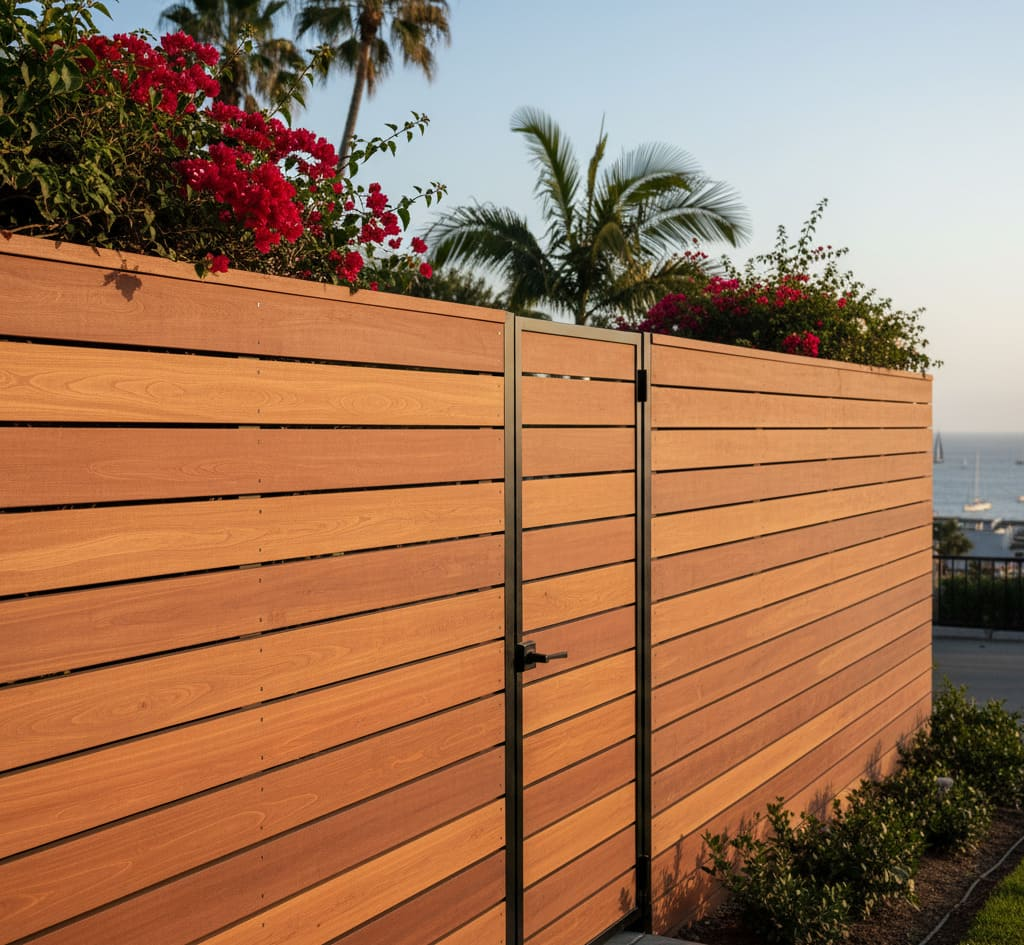
The Modern Look: Horizontal Wood Fencing
This is, by far, the most requested style for modern and contemporary homes in Santa Monica.
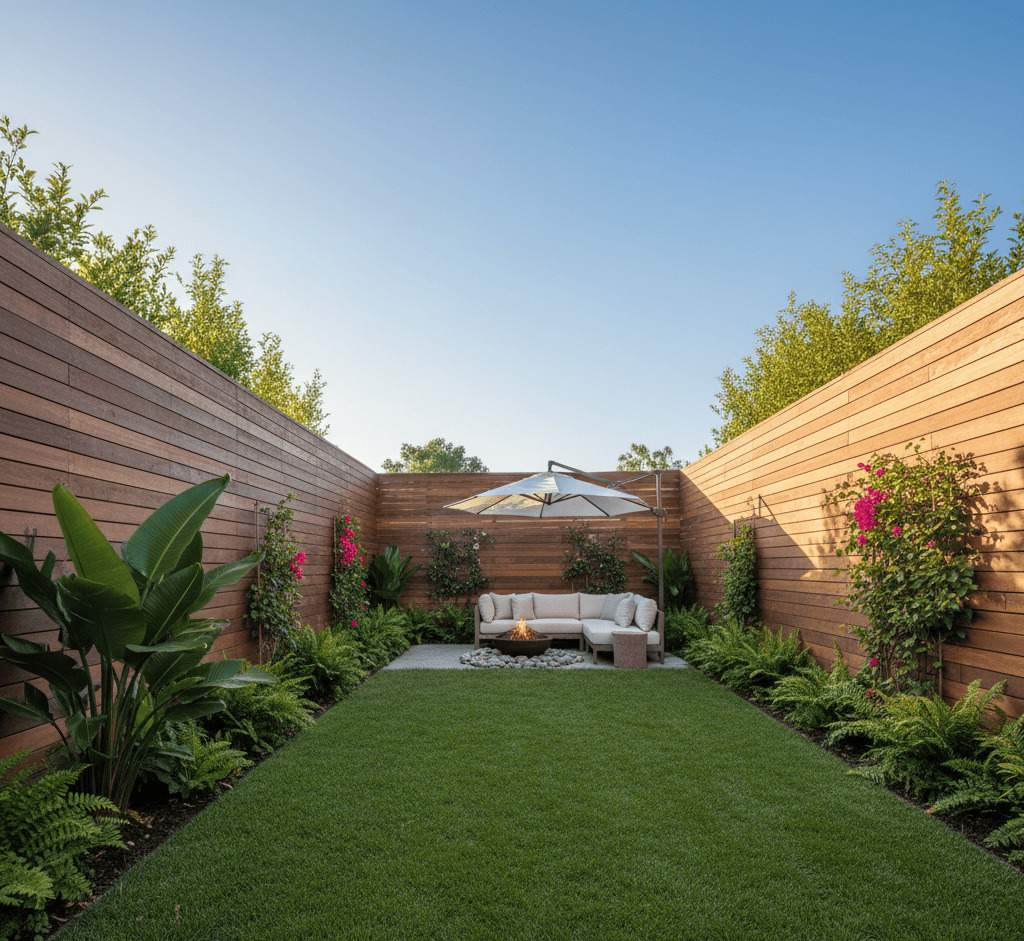
- The Design: Boards are run horizontally instead of vertically, creating a clean, sleek, high-end look. This style is popular in West LA, Mar Vista, and Santa Monica.
- Best Materials: This design requires a stable wood. We exclusively use Clear Redwood or Clear Cedar. Using PT pine would result in visible warping very quickly.
- Customization: We can customize the look by varying the board widths (e.g., alternating $1 \text{x} 4 \text{s}$ and $1 \text{x} 6 \text{s}$) or leaving small, uniform gaps between boards for a “semi-privacy” feel.
The Classic Look: Traditional Privacy & Picket Fences
These timeless designs are always in style and are excellent for defining property lines and creating secure, private spaces.
- Board-on-Board: A full privacy fence where vertical pickets overlap, ensuring no gaps and adding dimensional texture.
- “Dog Ear” Privacy: The classic, simple privacy fence with vertical pickets placed side-by-side. This is a cost-effective and popular style.
- Craftsman & Custom: This can include decorative elements like a lattice top, an “Asian style” open-slat design, or wall toppers to add height to existing masonry.
Part 5: The Overlooked Detail: A Durable Wood Fence Gate
A wood fence gate is the most common point of failure on a fence. It’s the one part that moves, bears weight, and is handled daily. Wood’s natural tendency to swell and warp with moisture can cause a gate to sag, stick, and become difficult to use.
At GAGA US Construction, our solution is to build a “gate that lasts.” For most of our custom wood gates, we fabricate a hidden steel frame. The wood pickets are then attached to this rigid, welded frame. This gives you the beautiful, matching look of a wood fence gate but with the structural integrity of steel, virtually eliminating sagging and warping for a gate that works perfectly for decades. We finish it with high-quality hardware and can integrate keypads, intercoms, and automatic openers.
Part 6: Critical Wood Fence Installation Details for Coastal Success
A beautiful redwood fence can fail in five years if installed improperly. In Santa Monica, the details of the wood fence installation are arguably more important than the material itself.
The Secret Weapon: Stainless Steel Fasteners
This is our number one non-negotiable rule for coastal building. The salt in the air is highly corrosive to metal.
- The Problem: Using standard or electro-galvanized screws will cause them to rust within a year or two. This rust will then bleed down the fence, creating ugly black and orange “tear stains” on the wood. Worse, the fastener will corrode, lose its strength, and fail, causing the fence to fall apart.
- The GAGA Solution: Our team uses only 316-grade stainless steel or double hot-dipped galvanized fasteners for every wood fence installation. This is especially critical for a cedar fence or redwood fence, as the natural acids in the wood can accelerate corrosion in lesser-quality fasteners.
Fighting Rot Before It Starts: Maintenance Best Practices
A wood fence installation from GAGA sets you up for success, but long-term survival depends on a simple maintenance plan.
- Stain and Seal Immediately (and Repeatedly): We recommend applying a high-quality, UV-resistant, waterproof stain or sealant to your fence immediately. This sealant is the fence’s primary defense. It must be reapplied every 1-2 years to prevent moisture from penetrating the wood.
- Ensure Proper Drainage: Wood’s worst enemy is standing water. We install fences so the pickets are a few inches off the ground, not in direct contact with the moist soil. We can also install a concrete or wood “gravel board” at the base as a buffer against ground moisture.
- Maintain Airflow: Trim bushes, ivy, and vegetation away from the fence. This allows sunlight and air to circulate, drying the fence out after the marine layer burns off.
Part 7: Why Choose GAGA US Construction as Your Wood Fence Company Santa Monica?
Choosing the right wood fence company Santa Monica is the most important decision you’ll make for your project’s longevity. An installer who doesn’t understand the coastal climate can leave you with a failing fence in just a few years.
- We Are Coastal Experts: We don’t just work in Santa Monica; we understand its specific climate. We know which materials fail and why. Our installation techniques—from using stainless steel fasteners to ensuring proper drainage—are designed specifically to combat salt air and humidity.
- True Craftsmanship: We specialize in the high-end, modern horizontal fences that define Santa Monica architecture. We build custom, steel-framed wood gates that won’t sag.
- Premium Materials: We source high-grade Clear Redwood and cedar fence materials that provide superior, natural durability. We don’t cut corners on the small things, because we know they’re the big things.
- Full-Service & Licensed: GAGA US Construction is a fully licensed, bonded, and insured contractor. We handle the entire project, from design and material selection to navigating the complex Santa Monica permit process.
Part 8: Final Recommendations & FAQ
Executive Summary: Which Wood is Right for You?
- Choose a Redwood Fence if: Your top priorities are maximum longevity and dimensional stability. You are building in a high-moisture area and want the best, most warp-resistant material available.
- Choose a Cedar Fence if: You want the beautiful, natural aesthetic and rot-resistance of a premium wood but are working with a more moderate budget.
- Choose a PT Pine Fence if: Your project is purely functional, budget is the primary driver, and you are not concerned with potential warping or cracking.
Frequently Asked Questions
- Q: How long will a wood fence Santa Monica really last?
- A: With proper, consistent maintenance (sealing every 1-2 years), a premium redwood fence or cedar fence can last 15 to 25+ years. Without maintenance, you may see significant decay in as little as 5-8 years.
- Q: How often do I really need to stain my new fence?
- A: We are not exaggerating. In this coastal climate, you must re-apply a quality waterproof sealant every 1 to 2 years. This is the single most important thing you can do to protect your investment.
- Q: What’s better for my Santa Monica home: a wood fence or a vinyl fence?
- A: It’s a clear choice between aesthetics and maintenance. A wood fence offers unparalleled natural beauty but requires a commitment to regular upkeep. A vinyl fence offers a clean look with virtually zero maintenance, making it the more practical choice for the coastal climate. If low maintenance is your priority, we recommend reading our guide to vinyl and composite fencing.