Part 1: The Santa Monica Challenge: Why Standard Fences Fail in Coastal Environments
Introduction: The High Stakes of Fencing in Santa Monica
At GAGA US Construction, we know a fence is a significant architectural and financial component of any Santa Monica property. It functions as a statement of design, a provider of privacy, and a line of security. However, in this unique coastal environment, a fence is also an asset under constant, severe environmental stress. The selection of fencing material is not a trivial decision; it is a long-term investment that we must ensure will perform under conditions that cause many traditional materials to degrade and fail prematurely.
The Three-Pronged Coastal Attack: Salt, Humidity, and UV Radiation
Properties in Santa Monica are subject to a more aggressive climate than inland areas, defined by a compounding, multi-pronged attack from the marine environment. Understanding these specific threats is essential to selecting a material that will endure.
Salt Air (The Corrosive Agent): The persistent ocean air carries microscopic salt particles that settle on every surface. This salt is a powerful corrosive agent that actively accelerates the breakdown of metals and coatings.
Humidity & Marine Layer (The Accelerator): The primary threat is the synergistic effect of salt combined with constant moisture. Salt deposits are hygroscopic, meaning they attract and retain moisture. The high humidity and persistent marine layer common in Santa Monica amplify salt’s corrosive effects, as materials rarely get a chance to fully dry. This creates a perpetually damp, corrosive environment.
Intense UV Exposure (The Degrading Agent): The relentless Southern California sun delivers intense ultraviolet (UV) radiation. This exposure breaks down chemical bonds in materials, causing paints and coatings to fail, colors to fade, and structural materials like plastic and wood to become brittle and degrade.
Why Traditional Materials Struggle
This unique coastal combination of salt, moisture, and UV light makes Santa Monica a high-risk environment for traditional fencing.
- Wood: While aesthetically classic, wood is highly vulnerable. It is a porous material that readily absorbs the salt-laden moisture from the air, leading to swelling, warping, and, ultimately, rot and decay. It becomes a cycle of constant, costly maintenance, requiring regular sealing and painting to prevent failure.
Of course, the classic, natural beauty of wood is undeniable. For property owners who love that traditional look and are prepared for the necessary upkeep, materials like cedar and redwood can still be beautiful options. (If you’re exploring that path, you can read our complete guide, ‘Classic & Modern Wood Fencing Ideas for Santa Monica (Cedar, Redwood & Pine)‘.) However, for a low-maintenance solution in this climate, synthetics are the clear choice.
Metal (Iron/Steel): Ferrous metals like wrought iron and untreated steel are exceptionally vulnerable. The combination of salt and moisture creates an ideal environment for rapid oxidation, or rust. While elegant, wrought iron demands rigorous, ongoing upkeep to prevent systemic corrosion.
The Modern Solution: The Rise of Synthetic and Composite Alternatives
In response to these challenges, modern synthetic and composite materials have become the premier choice for Santa Monica properties. Vinyl (PVC) and wood-plastic composite (WPC) are engineered to be impervious to the very threats that destroy wood and iron. Their value proposition is not just durability, but a low-maintenance, “fit and forget” solution that our team at GAGA US Construction stands behind and traditional materials cannot offer in this demanding coastal climate.
Part 2: Material Deep Dive: Vinyl (PVC) vs. Wood-Plastic Composite (WPC)
Understanding the composition of these two advanced materials is the first step in selecting the right one for a specific application.
Understanding Vinyl Fencing Santa Monica (PVC): The Minimalist Mainstay
What Is It?
A vinyl fence is a synthetic fence made from man-made plastic materials. The primary component, making up the vast majority of the material, is polyvinyl chloride (PVC).
Clarifying the Jargon: PVC vs. Vinyl
The terms pvc fencing and “vinyl fencing” are often a source of confusion for our clients, but they should be considered synonymous. PVC, or polyvinyl chloride, is a type of vinyl. When contractors and suppliers refer to a “vinyl fence,” they are referring to a product made from a PVC resin base.
How It’s Made: The Importance of Additives
Vinyl fencing is manufactured through a process called mono-extrusion, where the PVC-based compound is melted and formed into the final components (posts, rails, and pickets). The true performance of a vinyl fence, however, comes from the additives blended with the PVC resin. For a climate like Santa Monica, two are non-negotiable:
Titanium Dioxide ($\text{TiO}_2$): This is the essential UV inhibitor. It is a key ingredient in high-quality vinyl, acting as a powerful sunblock for the material. It protects the vinyl from the sun’s harmful rays, preventing it from breaking down, becoming brittle, and “prevents premature ageing and cracking”. This is the additive that allows a white vinyl fence to remain bright white and structurally sound for decades.
Impact Modifiers: These chemicals are added to the PVC blend to provide strength, flexibility, and resilience against impacts. They are crucial for preventing the shattering or cracking that plagued earlier, lower-quality vinyl products.
Understanding Composite Fencing Santa Monica: The Engineered Natural
What Is It?
Wood-Plastic Composite (WPC) fencing is a hybrid material, not a pure plastic. It is engineered from a blend of recycled wood fibers (such as sawdust, wood chips, or rice husks) and recycled plastics (such as high-density polyethylene (HDPE), polypropylene (PP), or sometimes PVC). This blend is combined with bonding agents, colorants for appearance, and UV inhibitors to create a dense, durable, and attractive fencing solution.
The Critical Difference: “Capped” vs. “Uncapped” Composite
The most important technical distinction in the composite market is not the core blend, but whether the product is “capped.”
Uncapped Composite: This is the first-generation version. The wood and plastic blend is exposed directly to the elements. In this design, the wood fibers, while protected, can still be a site for moisture absorption, staining, and fading. Uncapped products are “less scratch resistant and fade-resistant”.
Capped (Co-extruded) Composite: This is the modern, premium standard and the only type we recommend for a high-value Santa Monica property. This material is manufactured through “co-extrusion,” a process that adds a “protective extra coating” or “membrane” that acts as a shell, completely encasing the composite core. This polymer “shell” is a high-performance layer that locks out moisture and contains a high concentration of UV inhibitors, antioxidants, and colorants. This cap provides vastly superior protection against fading, staining, and scratches, ensuring the fence’s aesthetic and structural longevity.
At-a-Glance Comparison: Vinyl vs. Capped Composite
To aid in selection, the following table summarizes the core differences between the two materials.
| Feature | Vinyl Fencing (PVC) | Capped Composite Fencing (WPC) |
| Material Composition | 100% Polyvinyl Chloride (PVC) and additives. | A blend of recycled wood fibers and recycled plastics (WPC), with a protective outer polymer cap. |
| Feel & Texture | Smooth, clean, uniform, non-porous. A “minimalistic” plastic finish. | Textured, natural, wood-like feel. Often features embossed or simulated grain patterns. |
| Weight & Strength | Lightweight, flexible, easy to handle. | Heavy, dense, rigid. High impact resistance and sturdiness. |
| Coastal Performance (Salt/Moisture) | Excellent (Impervious). Non-porous and “inert to corrosion.” Does not absorb water. | Excellent (Resistant). Capped shell is waterproof. Stands up to salt water without degrading. |
| UV & Fade Resistance | Excellent (for white/light colors). $\text{TiO}_2$ provides inherent UV protection. Dark colors require specialized HHP formulations. | Excellent (when capped). High-performance UV inhibitors are concentrated in the outer cap to protect color. |
| Maintenance | Very Low. Occasional hosing with soap and water to remove dirt and salt residue. | Very Low. Occasional cleaning. No painting, sealing, or staining is ever required. |
| Sustainability | Not biodegradable. Manufacturing is energy-intensive. Can be recycled at end of life. | High. Often made from $95\%$ or more recycled plastic and reclaimed wood fibers, diverting waste from landfills. |
Part 3: Performance Under Pressure: Which Material Wins in Santa Monica?
A direct comparison from our decades of installation experience reveals that each material has specific strengths and weaknesses when faced with Santa Monica’s unique coastal challenges.
The Salt Air Test: Impervious vs. Resistant
When it comes to the corrosive salt-and-humidity combination, there is a clear technical winner: Vinyl (PVC).
Vinyl is a non-porous plastic. It “does not absorb water” and is “inert to corrosion”. It is, by its very nature, completely unaffected by salt and moisture. It “won’t rust in seawater” and is often cited as the “finest option” or “toughest option” for direct coastal exposure.
Capped composite is also rated as excellent for coastal use. Its protective polymer shell “stands up to salt water without degrading”. However, the core of the material still contains wood fiber, which is naturally hydrophilic (water-loving). While the plastic blend and, most importantly, the cap make it highly water-resistant, vinyl is inherently $100\%$ waterproof.
Verdict: For properties on the front lines—those on Ocean Avenue or Palisades Beach Road—we at GAGA US Construction believe vinyl (PVC) offers the highest possible degree of “peace-of-mind” material science against salt and moisture.
The UV & Heat Test: The Black Fence Complication
The intense Southern California sun presents a different challenge, especially for the increasingly popular trend of dark-colored fences.
The White Fence: As established, a white vinyl fence is inherently UV-stable. Its white pigment, Titanium Dioxide, is also its primary UV-blocker. It reflects sunlight, stays cooler, and resists degradation.
The Dark Fence Problem: Dark colors, by nature, absorb significantly more solar radiation and heat. This heat absorption can cause the material to expand, soften, warp, sag, and fade. This is a major risk in sunny climates that we see all across Los Angeles and Orange County. A standard, mono-extruded black vinyl fence is highly likely to fail.
There are two premium solutions to this problem:
High-Heat-Performance (HHP) Vinyl: This is a specialized, premium category of pvc fencing. Products like BLACKline HHP are specifically “engineered to resist the intense California sun”. They use advanced, high-temperature formulations and robust UV protection packages to allow the vinyl to withstand the heat without warping or fading.
Capped Composite: High-quality capped composite performs well in heat. Its rigid, dense structure helps it resist the sagging and warping that can plague standard vinyl. The UV inhibitors in the cap provide excellent color retention. However, some sources note that even dark composite colors can be prone to fading over long periods of sun exposure.
Verdict: The trend for a black vinyl fence Santa Monica or a modern black composite fence is a premium choice. It requires a premium, specialized product (HHP Vinyl or Capped Composite) to ensure a long-lasting investment. This is not just a color choice; it is a significant technical and budgetary upgrade we help our clients navigate.
The Durability & Strength Test: Cracking vs. Scratching
Our analysis explores physical, real-world durability and reveals opposing failure modes.
Vinyl (PVC): Vinyl is a flexible material. This flexibility allows it to absorb impacts. However, in extreme temperature fluctuations (both hot and cold), this flexibility can be compromised. Vinyl “may become brittle in extreme cold” or even extreme heat, making it “prone to cracking” upon impact.
Capped Composite: Composite is “denser,” “heavier,” and “robust”. It generally “wins in the durability department” when it comes to “hard impact”. It is far less likely to break or splinter than vinyl. However, the material is more “susceptible to scratches and dents” and, if uncapped, staining. The development of the “capped” shell was a direct response to this vulnerability, making modern capped composite highly scratch-resistant, though not indestructible.
Verdict: A crack in a vinyl panel is a structural failure. A scratch on a composite panel is an aesthetic one. For high-traffic areas, properties with large pets, or areas near active landscaping, we find composite’s superior impact strength and rigidity make it the more durable choice.
Part 4: Defining Your Style: Popular Fence Designs in Santa Monica
The choice between vinyl and composite is often a decision we guide our clients through, weighing two distinct aesthetic philosophies: the “manufactured minimalism” of vinyl or the “engineered nature” of composite.
The Clean & Classic Look: White Vinyl Fence Santa Monica
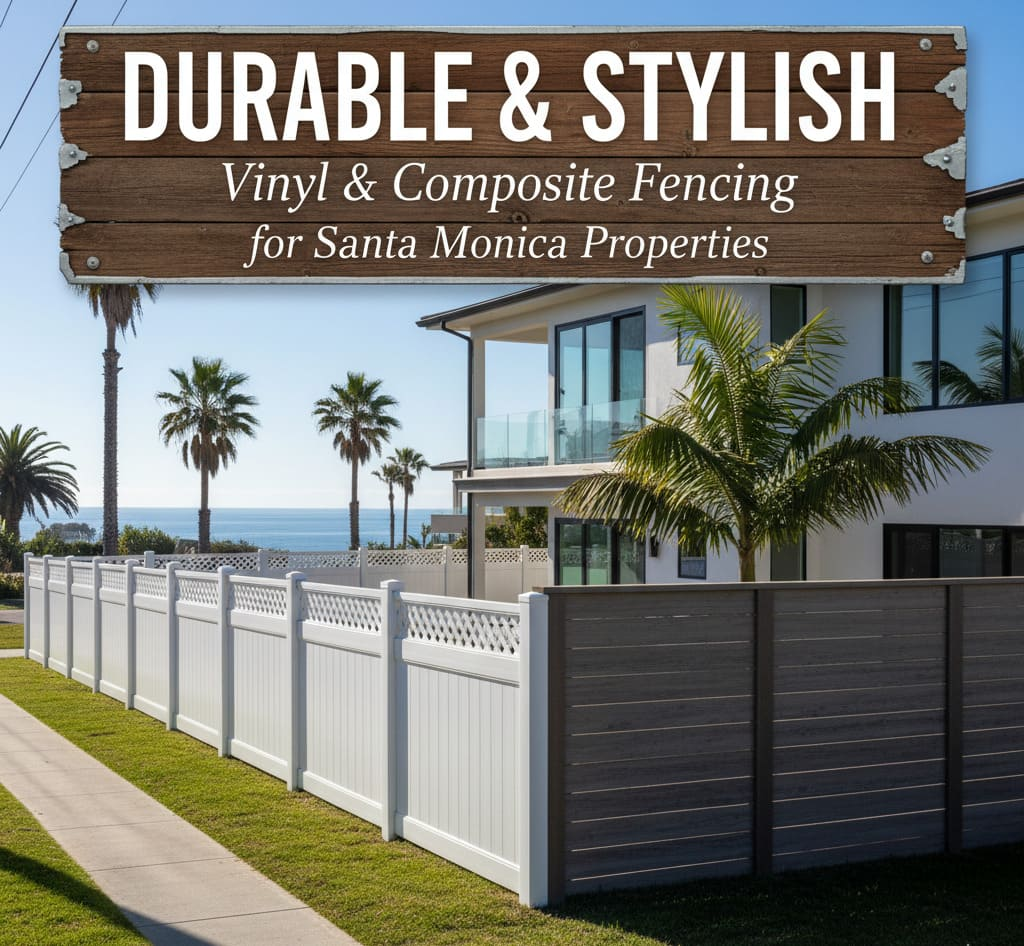
Vinyl fencing is the backbone of the classic, clean coastal look. Its smooth, uniform finish provides a “timeless elegance” that is highly popular in Santa Monica. At GAGA US Construction, we’ve installed a wide range of popular styles:
Full Privacy: Solid pvc fencing panels are the standard for backyard security and seclusion, creating a peaceful private space.
Classic Picket: The quintessential front-yard fence, a white vinyl fence in a picket style adds “timeless charm”. These are often customized with decorative elements like scalloped tops or “dog eared” pickets, and finished with New England-style post caps.
Semi-Privacy & Lattice-Top: A very popular compromise, these designs incorporate spacing or a lattice top to allow for airflow and light, enhancing elegance while maintaining privacy.
Ranch Rail: Typically used on larger lots or as decorative boundaries, 2-rail or 3-rail vinyl ranch fences are a low-maintenance way to define a property line.
The Natural & Premium Look: Composite’s Wood-Grain Aesthetic
Composite fencing is for the property owner who desires the “look of natural wood without the associated drawbacks”.
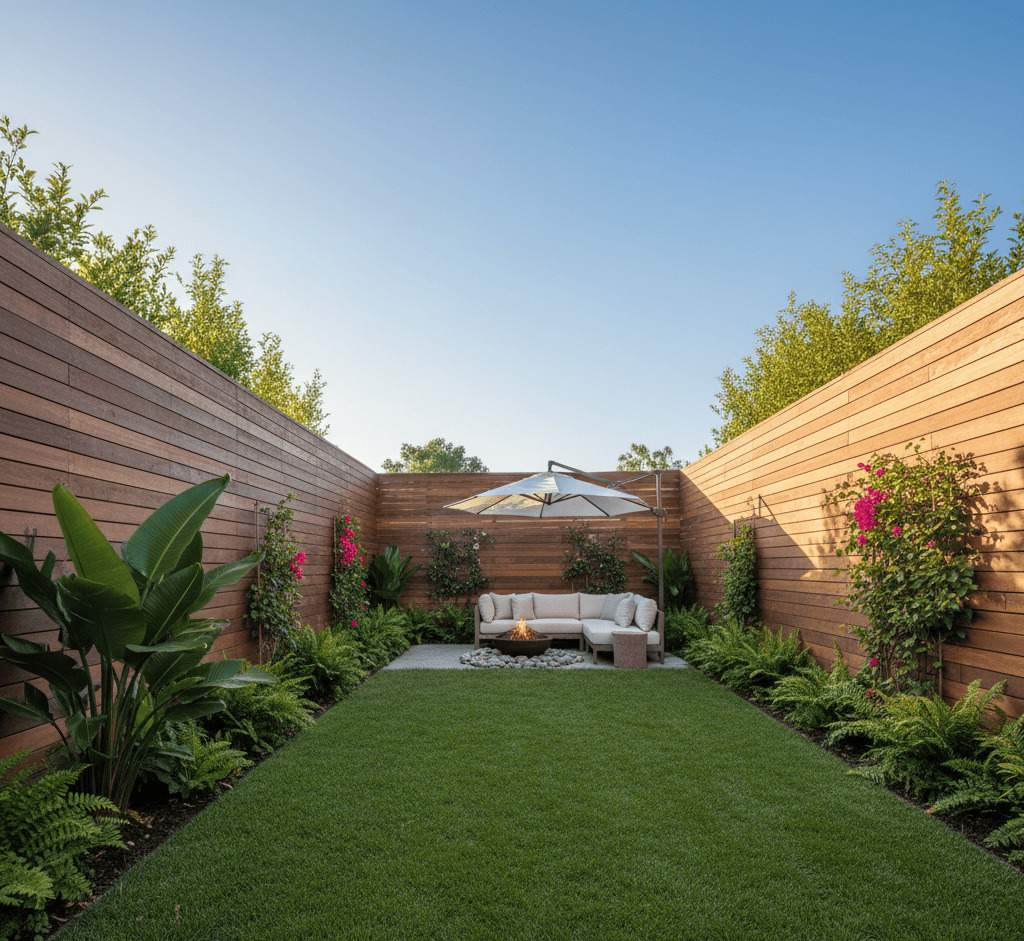
This material provides a “warm, authentic appearance” defined by its “textured finish” and “earthy tones”. While some premium vinyls offer a “textured wood-grain finish”, composite’s blend of real wood fibers creates a depth and natural-looking texture that a pure plastic surface struggles to replicate. This makes composite the ideal choice for homes aiming for an organic, upscale, or rustic-modern aesthetic that needs to blend seamlessly with landscaping.
Leading brands like Trex offer designs such as a “Board-On-Board” system with interlocking pickets, which provides full privacy and the significant advantage of having the same finished, “natural” look on both sides of the fence.
The Modern & Edgy Look: The Rise of Black Fencing
A powerful trend in Santa Monica design is the use of black fencing to create a “chic,” “sleek,” and “modern” statement.
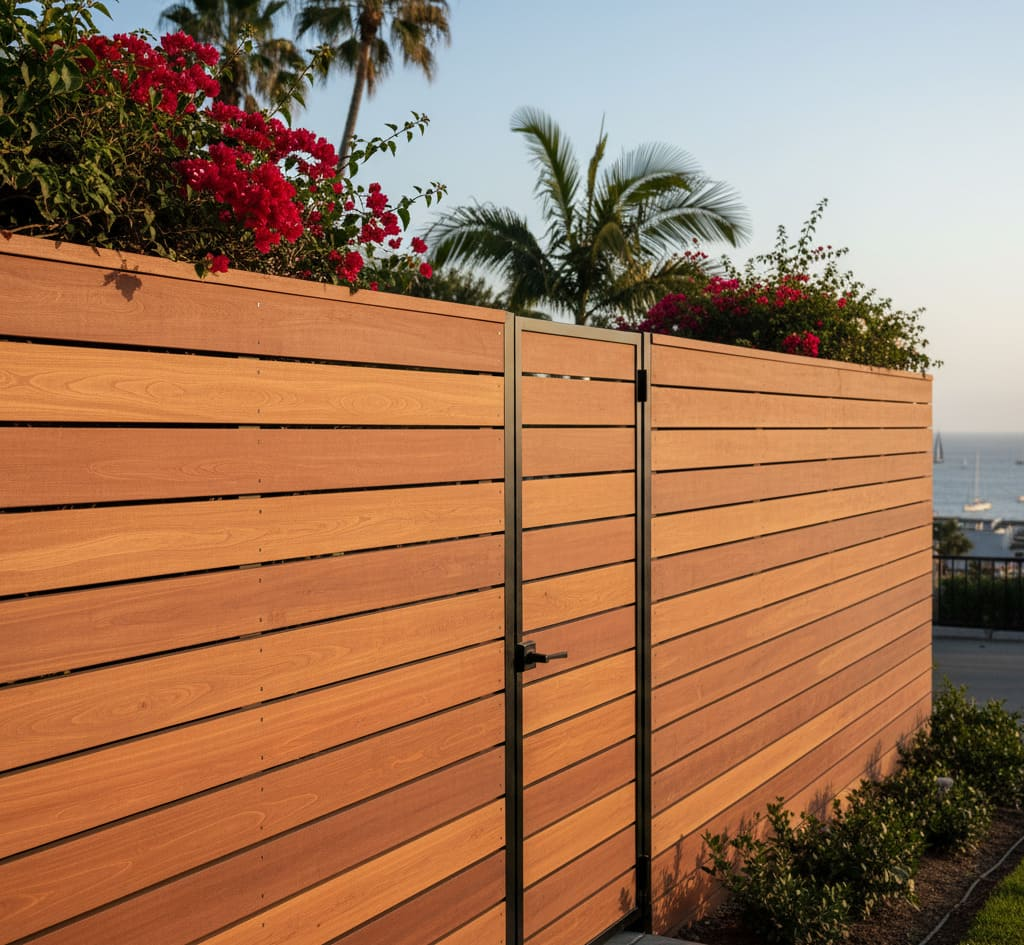
Both materials are used to achieve this “bold, lasting beauty”. A black vinyl fence or a black modern composite fence creates a sharp, defined perimeter. This style often features clean lines and horizontal panels and is particularly effective as a dramatic backdrop that “contrast[s] with bright red flowers and green palms”. As noted in Part 3, this aesthetic choice must be paired with a premium, high-heat-performance material to ensure it withstands the Santa Monica sun.
Part 5: A Comprehensive Cost Analysis for Santa Monica Properties
A transparent analysis of vinyl fence cost and composite fencing cost reveals a significant price differential, which we believe in being upfront about.
The Single Most Important Insight: Local vs. National Cost Data
We always advise our Santa Monica clients to be extremely wary of generic, national cost estimators. Data from national home improvement websites suggests vinyl fencing costs $\$15$ to $\$40$ per linear foot and composite costs $\$11$ to $\$45$ per linear foot. This data is not reflective of the Santa Monica market.
The reality, as reflected in our local pricing experience, is dramatically different. Local pricing data provides a much more accurate baseline:
This hyper-local data shows that high-quality vinyl is 2-3 times more expensive than national averages, and premium composite is 3-4 times more expensive.
Breaking Down the Investment: A 2024/2025 Santa Monica Cost Estimate
Synthesizing local and national data provides a realistic budget tool for a professionally installed fence in the Santa Monica area.
| Fence Type | Estimated Cost (Per Linear Foot, Installed) | Data Sources |
| Standard White Vinyl Privacy Fence (6-ft) | $\$53.00 – \$70.00$ | |
| Premium Vinyl (e.g., Wood-Grain, Black HHP Vinyl) | $\$65.00 – \$90.00$ | |
| Premium Capped Composite (e.g., Trex) | $\$120.00 – \$155.00+$ | |
Note: Prices are estimates and will vary based on project complexity, terrain, and specific contractor.
Why is Composite So Much More Expensive?
The $120\%$+ price premium for composite fencing is not arbitrary. It is a reflection of several factors:
Complex Manufacturing: The “mix of recycled wood fibers, plastics, and bonding agents” undergoes a “more complex” manufacturing and co-extrusion process than vinyl mono-extrusion.
Material Density: The resulting product is “heavier” and “more durable” than its vinyl counterpart.
Labor-Intensive Installation: Composite’s significant weight “may require more structural support” and is more demanding on our installation crews, which “can increase labor time and costs”.
The Lifetime Value Calculation: Upfront Cost vs. Long-Term Worth
The financial analysis we provide must extend beyond the initial quote.
Maintenance Savings: The long-term value of both materials comes from eliminating the maintenance costs of wood. A wood fence requires $\$150$ to $\$300$ per year in staining, sealing, and repairs. The maintenance costs for vinyl and composite are near-zero, often limited to $\$50$ annually for soap.
Lifespan: Composite generally has a longer advertised lifespan, at $25$ to $30+$ years, compared to $20$ to $25$ years for vinyl.
Resale Value: Because vinyl is a more common, cost-effective solution, it may not add as much to a home’s resale value. Composite, with its “premium, natural look” and superior durability, is often seen as a significant property upgrade. This “wood-like aesthetic” appeals to design-savvy buyers and can “boost property value”.
The analysis is clear: the significant premium for composite fencing is not for lower maintenance; both materials excel here. The $\$120/\text{ft}$ price is a capital investment we help our clients make in a longer asset life and a superior, premium aesthetic that may yield a higher return upon resale.
Part 6: Installation, Permits, and Finding a Pro in Santa Monica
A flawless material can be ruined by a flawed installation. In a climate of temperature extremes, proper installation is not just a recommendation; it is a structural necessity.
The Non-Negotiable: Professional Vinyl Fence Installation Santa Monica
While vinyl’s lightweight nature may appeal to the DIY-er, we at GAGA US Construction highly recommend professional installation for any high-value property. The primary reason is not labor, but technical expertise. Composite, being heavier and more complex, almost always requires a professional crew.
The Most Common (and Costly) Installation Mistake: Thermal Expansion
The single greatest point of failure for synthetic fencing is the failure to account for thermal expansion and contraction.
The Physics: Both vinyl and composite materials “expand in the heat and contract in the cold”. This is a normal, expected behavior. A GAGA US Construction professional installer accounts for this movement; an amateur does not.
The Consequence of Failure: If panels are installed too tightly without “room to ‘breathe,'” the material will have nowhere to go when it expands in the Santa Monica sun. This “will cause the same type of compromise in the fence structure”, leading to panels buckling, warping, and bowing, creating a wavy “rollercoaster” appearance. This damage is irreversible and not covered by warranties if due to installer error.
The Professional Specs: A professional GAGA installation is precise. For vinyl, this means leaving “a $\frac{1}{4}$” gap between panels and rails” and a “$\frac{1}{16}$” gap between the screw head and the fence panel”. For composite, installers must “leave small gaps—at least $5 \text{mm}$—between panels to accommodate this movement”.
Other common, costly mistakes include setting posts in shallow holes (a depth of $600$-$850 \text{mm}$ is often required), failing to check property boundary lines, and not accounting for ground slope.
Navigating Santa Monica’s Fence Regulations (The Local Code)
Our team at GAGA US Construction is fully versed in the City of Santa Monica’s municipal code, as all installations are subject to strict regulations.
Height Restrictions: The city has specific height limits based on location:
Front Yard: Maximum fence height is typically $42$ inches ($3.5$ feet).
Backyard / Side Yard: Fences can reach a maximum height of $8$ feet, though $6$ feet is the common standard.
Note: The city has been actively seeking public input on ordinance updates, particularly regarding front yard fence heights in multifamily ($\text{R2}$, $\text{R3}$, $\text{R4}$) zones, so always check the current code.
- Permit Requirements: “Do I need a permit for a 6-foot fence?”
Navigating the permit code can be confusing. The city’s municipal code states that a building permit (a complex, structural review) is NOT required for “Exterior freestanding walls and fences not over six feet high”.
However, other city resources state a permit is “typically required”, and the city website lists “fences/walls” under its “Single-Trade Building Permit Application”.
This is not a contradiction. The expert conclusion is that while a 6-foot fence is exempt from a full-scale building permit, it is subject to a simpler “Single-Trade” or zoning permit. This allows the Santa Monica Department of Building and Safety to review the project for compliance with all critical height, setback, and “hazardous visual obstruction” rules